
Publishing: Then & Now with Alison Owings
For more than three decades, the oral historian behind Frauen, Hey, Waitress!, Indian Voices, and Mayor of the Tenderloin has written books from other people’s memories. For the first installment of Publishing: Then & Now, I asked her to remember her own life in books.
When Alison Owings was trying to become a published author in the early 1990s, she typed letters to prospective agents and received typed letters back. Once she had an agent, rejection letters from publishers arrived through the mail. And when someone finally wanted to see the manuscript that would become Frauen: German Women Recall the Third Reich, Owings typed it on what she remembers as “good paper, some fancy bond saved for such august occasions,” carefully put it in a box, and mailed it.
“The process is the same, but the medium is not,” she told me. “Think: paper.”
The basic route she took into publishing would still be familiar to many writers today. “I’m a traditionalist—except in my subject matter—so basically, then as now, I wrote, looked for an agent, and my agent looked for a publisher,” she shared. What has changed is what moving through that process looks like. A query can now reach an agent in seconds; a manuscript can cross the country just as quickly. For someone who entered publishing after email—after TikTok, really—the physical effort Owings remembers can sound almost quaint. To her, it was simply how the industry once worked.
Owings has spent much of her writing life asking other people to remember. Oral history is interested not only in what happened, but in how it is recalled: the person whose name comes immediately to mind, the detail someone still finds funny, the experience that looks different in retrospect. So when I wanted to understand what more than 30 years of publishing looked like from inside one writer’s career, Owings seemed like an especially fitting person to ask.
Before becoming an author, she had already worked in television news in Washington, D.C., and New York, including at CBS News in the 1970s, where she wrote broadcast copy for Walter Cronkite. Books gave her room for a different kind of reporting. Instead of compressing people’s experiences for broadcast, she could stay with their contradictions, digressions, and memories.
That became the method behind four very different books. Frauen, published by Rutgers University Press in 1993, grew from interviews with 29 German women whose experiences under Nazism resisted easy moral categories. Hey, Waitress! The USA from the Other Side of the Tray, published by the University of California Press in 2002, explored class, labor, gender, and dignity through women working in food service. Indian Voices: Listening to Native Americans, published by Rutgers in 2011, focused on contemporary Native lives. And in 2024, Beacon Press published Mayor of the Tenderloin, built from nearly a decade of conversations with Del Seymour, the founder of Code Tenderloin, and the people around him.
Over those three decades, Owings became a more experienced writer and interviewer and worked with different agents, editors, publishers, and publicists. Publishing changed around her, too. For the first installment of YPA’s blog series, “Publishing: Then & Now,” Owings joins us to remember people, books, lucky breaks, disappointments, and relationships that worked—or did not.
The people who make the book
“The relationships have always been individualistic and therefore complicated,” Owings emphasized. “I myself left two agents, one a superstar.”
That is one reason she resists nostalgia about publishing. A famous agent can still be the wrong agent. A prestigious publisher does not guarantee the right experience. Careers are shaped by relationships among people with different tastes, expectations, ambitions, and temperaments—and those relationships are also shaped by money.
“What’s probably changed the most is money,” Owings said. In her view, publishers are less willing to take chances on unknown writers and more likely to concentrate larger investments on authors they already expect to sell well.
She also believes editors are more overworked than they once were, with less time to devote to individual books. Her own experience, however, has included unusually close editorial relationships. Leslie Mitchner gave Frauen the kind of close attention Owings still remembers more than 30 years later. At Beacon, Joanna Green “basically restructured” Mayor of the Tenderloin.
“Good editors are gold,” Owings said.
Her books make it easy to understand why. Frauen began with 29 individual accounts that had to be arranged and put into context without smoothing away their contradictions. Mayor of the Tenderloin grew from nearly a decade of conversations with Seymour, along with interviews with family members, friends, police, social-service workers, activists, philanthropists, and people involved with his programs. All of that material had to be shaped into a book.
Editing tools have also changed dramatically. Digital change-tracking now lets authors and editors see who changed what, when, and where, while cloud-based documents allow several people to work in the same manuscript at once. A 2022 study of digital editing tools notes that modern systems can preserve the authorship, timing, location, and content of individual revisions. More recently, AI-powered tools have begun offering everything from grammar checks to developmental feedback. Publishers Weekly reported in 2025 on platforms like AutoCrit and Editrix entering the editing process. Despite the development of these platforms, AI’s role remains contested. In 2026, the Authors Guild called on publishers not to use AI for substantive manuscript editing, apart from basic spelling and grammar checks.
What has not changed is the central editorial work: someone still has to decide what belongs, what needs more context, what should move, and what the book is ultimately trying to become.
Who gets noticed?
Frauen was Owings’s first book, and it received a level of attention that would be remarkable at any point in a writer’s career. Kirkus Reviews called it oral history at its best. The Los Angeles Times reviewed it prominently. The New York Times named it a Notable Book of the Year.
But one occasion stands out, especially in Owings’s memory: “A featured review in The New York Times Book Review did it for us!”
It is difficult to know exactly what comes first when a book begins gathering momentum: strong reviews can generate more attention, while early enthusiasm can also make more outlets take notice. What Owings remembers clearly is that Rutgers did not ask her to do much beyond radio appearances. She was hardly passive, though. Before email or social media made direct outreach routine, she organized her own college speaking tours, both to discuss Frauen and to earn money, and even hired a publicist friend to arrange Bay Area events.
Authors, in other words, were promoting their own books long before social media. What changed was the number of ways they could do it—or be expected to do it.
By the time Hey, Waitress! printed in 2002, Owings was no longer a debut author. The book received strong attention of its own: Publishers Weekly praised its combination of social and oral history as a trailblazing contribution to the study of women and work.
Then came Indian Voices. By 2011, Owings had nearly two decades of publishing behind her, a clear method, and a strong review history. Publishers Weekly and Library Journal both gave the book starred reviews.
As a publicist, I sometimes find myself looking back at an earlier media landscape with envy. A major review in a national newspaper or magazine could concentrate an extraordinary amount of attention on a single book. Today, that attention is spread across far more outlets and platforms. But the earlier system was never predictable either: a glowing review could transform a book’s prospects without guaranteeing a large audience, and one book’s success did not ensure the same reception for the next.
Owings’s career highlights this. Even as an author becomes more established and practiced, there is no guaranteed immunity from the problem of being noticed. It’s a series of repeated efforts, over and over again, and with new learnings each time, that turns writing into publishing, publishing into publicizing, publicizing into perhaps writing and publishing again.
By the time Mayor of the Tenderloin appeared, there were also many more places where that attention might come from. Bookstore events, reviews, radio, television, lectures, and word of mouth now sit alongside podcasts, newsletters, virtual events, social media, and direct communication with readers.
Beacon held a Zoom meeting with Owings, Seymour, and others to discuss marketing and suggested that she might not need outside publicity for the hardcover.
“I didn’t for the hardback,” she later wrote to me, “but as you know....”
And I do know. Owings eventually hired my agency, Punctuation PR, to work on publicity for the paperback, which is how we came to know each other professionally.
More than 30 years separate the publicist Owings hired around Frauen from our project for Mayor of the Tenderloin. But the need to help a book find its readers has yet to go away.
More ways to publish—and to find readers
Self-publishing is one change Owings views very differently now than she once did.
“At least in my cohort,” she said, it had “the whiff of desperation.”
She remembers its association with vanity presses and writers paying to print books that traditional publishers would not take. Her view has softened considerably.
“Those harrumphs have morphed into oh wells and ahas.”
The numbers show how dramatically the landscape has changed. According to Bowker, more than 3.5 million self-published print and e-books with ISBNs were released in the United States in 2025, up nearly 39 percent from the year before. Traditional publishers released about 642,000 titles. Self-publishing is no longer a marginal part of how books enter the world; by title count, it now represents the large majority of new U.S. books registered with ISBNs.
That does not mean the distinction between self-publishing and traditional publishing has disappeared. Reviews, prizes, bookstores, and libraries can still be harder for independently published authors to access. But the old assumption that a book published outside the traditional system is inherently less legitimate has become much harder to maintain.
As Owings pointed out, “And sometimes one mentions, well, Virginia Woolf was self-published....”
The number of formats has expanded, too. Mayor of the Tenderloin became Owings’s first book to be released as an audiobook. Audio is now a substantial part of the industry: U.S. audiobook revenue reached $2.43 billion in 2025, up 9 percent in a single year, while publishers reported more than 750,000 active audiobook titles. The Audio Publishers Association estimates that 58 percent of American adults have listened to an audiobook.
Set beside the typewriter and manuscript box Owings remembers from Frauen, it is a striking expansion of what publishing a book can mean. A book might now appear in hardcover, paperback, ebook, and audio; be discovered through a bookstore, a podcast, Goodreads, Instagram, or TikTok; and develop an audience in communities that barely existed (or perhaps even were not yet born!) when Owings published her first book.
But the rise of those newer channels has not simply pushed older ones aside. Print sales remain remarkably hardy: Americans bought more than 762 million print books through outlets tracked by Circana BookScan in 2025. Hardcover and paperback books together still accounted for more than 73 percent of U.S. trade publishing revenue that year.
Want a drink?
I asked Owings whether there was a publishing problem people tend to think of as new that she recognized from earlier in her career.
“I don’t know,” she said. “Problems are accruing.”
She mentioned smaller advances—“not that I ever got much”—concerns about fewer Americans reading, and the rise of audiobooks. Her answer was less a verdict on whether publishing has improved or declined than an acknowledgment that change rarely happens by simple replacement. Some things disappear. Many remain. New pressures and possibilities are added alongside them.
AI is one change she finds harder to connect to anything that came before.
“AI is the bogeyman to us all,” she said.
The Authors Guild now offers a “Human Authored” certification for books written by people rather than generated by AI. Publishing has reached a point where something that would have seemed too obvious to state when Frauen appeared can now be presented as a distinction: a person wrote these words.
For an oral historian, the question of who is speaking is hardly abstract. Owings has spent decades recording other people’s words, deciding how to place them in context, and taking responsibility for how their stories appear on the page. She began her book career typing human testimony onto paper. More than 30 years later, the industry is debating what it means for a book to be human-authored at all.
That contrast makes it tempting to divide Owings’s career neatly into an old publishing world and a new one. Her memories resist that.
After our conversation, she sent me a photograph.
It was taken in November 1993, shortly after Frauen was published. Owings had arrived late to A Clean Well-Lighted Place for Books in San Francisco for a reading and Q&A and was, as she remembers it, “a nervous wreck.” Backstage, the bookstore’s publicist, Kimberly Burns, took one look at her.
“Want a drink?” Burns asked.
Burns would later work in publicity at Knopf, Random House, and Pantheon before becoming an independent literary publicist. Owings would go on to publish three more books.
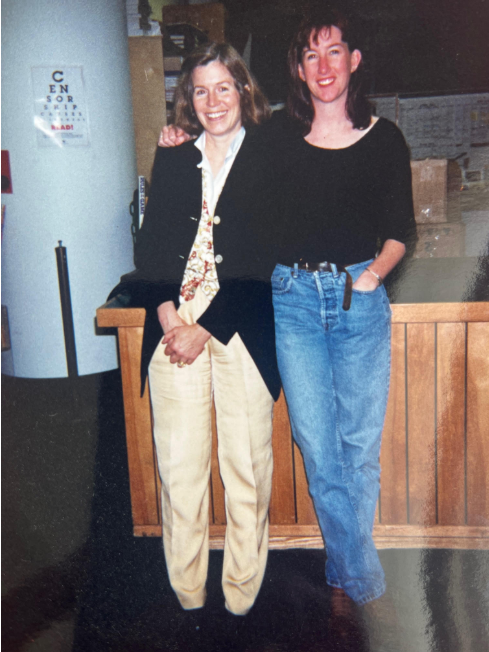
Photo caption: Alison Owings with Kimberly Burns backstage at A Clean Well-Lighted Place for Books in San Francisco before a reading and Q&A for Frauen: German Women Recall the Third Reich, circa November 1993. Photo courtesy of Alison Owings.
A history of publishing can tell us what changed between Frauen and Mayor of the Tenderloin: manuscripts became digital, new formats and publishing routes emerged, publicity spread across more platforms, and entirely new questions about authorship appeared.
Owings remembers the industry in more personal terms. She remembers speaking to hundreds of college students, corresponding with editors, leaving agents, hiring publicists, waiting for reviews, and arriving nervous for a bookstore reading. She thinks of the people attached to each book.
More than 30 years later, that may be what a told account of publishing preserves best: not only how books were made, but who was there while they were being made. The tools and structures around publishing will continue to change, but books still move through the world because people choose to write them, shape them, champion them, and read them.
— — — — — — — — — — — — — — — — — — — —
Ellen Yang is a publicist and the founder of Punctuation PR, where she works with authors, scholars, and other public thinkers on book publicity, marketing, and operations. She earned her B.A. from Stanford University and writes about books, publishing, and literary culture.
